Wildlife loss and its reduction to images
H is for HawkWildlife loss and its reduction to images names a double disappearance in Helen Macdonald’s account: animals vanish from their habitats and from everyday experience, while representations of them become more familiar than the living creatures themselves. As rarity narrows what an animal can mean, it risks becoming an emblem of its own loss. Macdonald tests that idea against a gallery image of the California condor, a dead Spix’s macaw, her life with Mabel, and the ecological histories concealed beneath apparently familiar countryside.
Rarity and the image of the condor
At an art exhibition, Macdonald enters what first seems an incongruous construction: a full-sized bird hide made of rough-hewn pine, an exact copy of a real hide in California. Visitors peer through its window at a projection filmed from the original structure. A soaring California condor appears on the screen, but the gallery’s convincing arrangement cannot restore the conditions of meeting a living bird. To Macdonald, the image feels attenuated beside her memory of condors encountered at a captive-breeding centre: large, untidy, curious, and individual birds rather than a single legible emblem.
The condor’s history makes that difference painful. Persecution, habitat destruction, and lead poisoning from contaminated carcasses had brought the species close to extinction. By the late 1980s, only twenty-seven birds remained. In an effort to save the species, conservationists captured the remaining wild birds and used their captive-bred young to repopulate the wild. Some people opposed the plan, sincerely fearing that a condor kept in captivity would cease to be wild. The dispute exposes a difficult conservation problem: the measures intended to prevent disappearance can place the animal in a human-controlled setting, where arguments about what counts as wild become part of the effort to save it.
Macdonald’s impatience with the projected bird is also a check on her own expectations. At first, her attention is full of actual skies and actual hawks; she judges the image against the living condors she remembers. She then recognizes that the gap is the exhibition’s point. The projection shows how an animal can persist as a public image while direct, ordinary acquaintance with it diminishes. As a species becomes rarer, extinction may come to seem like its chief meaning. The condor becomes an icon of loss and hope, yet those meanings can crowd out its particularity.
Living animals and human meanings
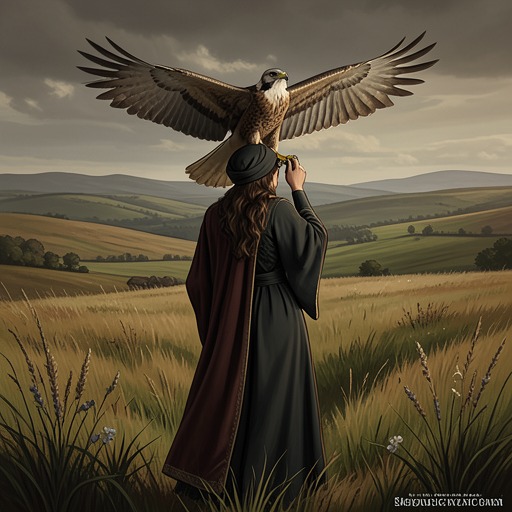
Macdonald sets the gallery’s distant view against her close, daily relationship with Mabel. The contrast is not simply between a false image and an authentic encounter: keeping and training a hawk also places an animal within human practices and meanings. But sustained attention makes Mabel more, not less, difficult to reduce to a symbol. Macdonald learns to read minute changes in the hawk’s posture and feathers, using them to judge her mood and anticipate her actions. That attentive process makes the bird’s responses consequential in the shared life between them.
Mabel’s play gives this point a particularly clear form. She turns her head to inspect a crumpled strip of paper, grasps and crunches it, and engages with a rolled magazine as Macdonald looks through it like a telescope. Mabel ducks to look back, pushes her beak into the tube, and responds with raised forehead feathers and a rapidly moving tail. Macdonald is struck by the mismatch between this playful, particular bird and the fixed idea of goshawks she had absorbed from books. The encounter does not make Mabel a transparent expression of human feeling: it confronts Macdonald with behavior she had not expected and forces her to revise her assumptions.
The contrast becomes sharper when Mabel first eats from Macdonald’s hand in the company of Christina. Macdonald had imagined the moment occurring in solitude and darkness, but it happens in daylight, with the television on and another person reading. The hawk’s calm, then her hunger and evident pleasure, do not follow the human scene Macdonald had prepared for them. Such episodes give her knowledge of Mabel that a screen cannot provide: not an abstract image of a hawk, but a relationship shaped by the bird’s actions and by the human work of watching and responding. For Macdonald, that intimacy deepens the animal’s complexity without erasing the ethical questions involved in keeping a wild creature.
Extinction as memory and inheritance
The gallery’s other exhibit is a Spix’s macaw displayed dead in a glass case. None remain in the wild, and the last captive birds are the focus of efforts to keep the species alive. The specimen makes extinction present through an individual body rather than a moving image. It also leads Macdonald back to her father’s death: seeing the bird recalls the hospital room where she spoke to her father’s body and waited, briefly, for an answer. The connection does not make the parrot merely a substitute for her father. Rather, the encounter shows how a representation or preserved body can gather personal grief around a larger knowledge of loss.
Elsewhere, an encounter with a diseased rabbit draws the ecological past into the present. Myxomatosis arrived in Britain in 1952; within two years the virus had killed ninety-five per cent of the country’s rabbits. Their decline altered grasslands and contributed to falls in predator populations, and outbreaks still occur even though the virus is now less virulent. To Macdonald, the afflicted rabbit also recalls childhood fears shaped by widespread environmental damage: dying wildlife, poisoned rivers, and the possibility of nuclear catastrophe. Grief, in this account, does not proceed as an orderly personal history. It brings earlier states of fear and older ecological crises back into view.
Reading J. A. Baker’s The Peregrine likewise changes under the pressure of that history. Macdonald had remembered it as a poetic celebration of nature; rereading it, she finds a darker vision in which the falcons seem bound to death and annihilation. She contrasts Baker’s bleakness with T. H. White, who, despite his disastrous relationship with Gos and his attraction to cruelty, still fought against death and hoped for miracles. These writers influence how readers encounter birds: friends who read Baker before seeing a live peregrine may associate the real bird with distance, extinction, and death. The image is not an innocent substitute for experience; it can shape what experience is allowed to mean.
Remembering what a landscape has lost
The same problem of disappearance extends from individual species to whole landscapes. Macdonald observes that fields can retain the broad appearance of countryside while losing much of their life. On chemically treated farmland, large animals may still be present, but plants, bees, and butterflies are scarce. Her account sets this impoverished present against earlier records: turtle doves there ten years before, corn buntings and large lapwing flocks thirty years before, and, further back, red-backed shrikes, wrynecks, snipe, ravens, and black grouse. The sequence makes visible a loss that a familiar-looking field might otherwise conceal.
Macdonald calls Old England an imaginative construction assembled from words, woodcuts, films, paintings, and picturesque engravings. Such images can offer solace while obscuring ecological change: people live briefly, misjudge scale, and cannot readily remember species they have never known. The apparently continuous landscape thus becomes an image of continuity that can hide successive disappearances. Against that inherited picture, Macdonald argues for attention to living variety rather than attachment to scenery that merely reflects an idea of national identity.
The concept does not make images worthless or claim that every encounter with an animal escapes human interpretation. It shows instead how images, memories, and conservation arguments can either narrow or complicate what people perceive. A projected condor can make extinction visible, yet also reduce a bird to an icon; a living hawk can unsettle inherited categories, yet remain part of a human relationship with its own forms of control. By holding those tensions together, Macdonald treats wildlife loss not only as the disappearance of animals, but also as a change in the kinds of knowledge, meanings, and attachments through which people might notice and care for them.